Archive for the ‘Market commentary’ Category

I like the idea of solar PV.  It works, it fits in.  But for investors it’s like riding a bull in an arena because solar is still highly dependent on governmental support.  When the support weakens watch out.   Here are some examples.

First  March  10, 2011 Energy Conversion’s CEO  [ENER] reported that a dramatic and abrupt shift in the French and Italian solar incentive structures has impacted our business and that the changes may impact as much as 50% of this quarter’s forecasted revenue”.   The next day ENER promptly lost 21.5% of its market value.

Next, Renewable Energy Corporation [REC.OL] succumbed to the chill blowing through the solar energy market on May 24, 2011 with a plan to cut output and lay off 500 workers, sending its shares tumbling.  The maker of wafers, cells and modules for the solar industry also warned second-quarter results would be much weaker than the first three months.  The solar industry — which depends on government incentives — has been hit by changes in subsidy legislation in Germany and Italy, the world’s No. 1 and No. 2 markets.  Its shares were down 14 percent at 8:19 a.m. EDT while Oslo’s main index was up 1.0 percent.

Most recently, PV Crystalox Solar [PVCS.L] announced on June 28, 2011  that, as a result of the widely reported adverse PV market conditions experienced in recent weeks, shipment volumes in the first half of the year will be slightly below the guidance of 210-225 MW given in their Interim Management Statement on 19 May 2011.   Of more concern were their statements about strong downward pressure on prices the hint  the Group may incur an operating loss in the second half.   The company concluded its announcement with a warning that it may not pay a dividend in 2011.   The market promptly rewarded these announcements with a 41% decline in its stock price.
The WSJ reported today that the SEC is investigating some accounting firms involved in audits of Chinese companies that subsequently engaged in reverse mergers to become listed on US exchanges.   It’s good the SEC is investigating these practices, after all we need all the protection from fraud we can get.  Apparently the NASDAQ also feels additional action is necessary since on April 18, 2011 it filed a proposed rule change with the SEC to add additional controls.

Many reverse merger companies are listed on OTC exchanges.   As I’ve mentioned before these exchanges are fraught with risk for individual investors and the SCE investigation is just another reminder of the dimensions of these risks.

Today Jason Zweig wrote in the WSJ about the various worries that government bond holders have.   Zweig’s biggest worry isnt’ default, but what economist Carmen Reinhart of the Peterson institute of International Economics calls “financial repression” or the use by governments of harsh methods to dig out from under burdensome debts.   One example would be keeping short-term interest rates below the level of inflation so a government can pay off debt with cheapening money.

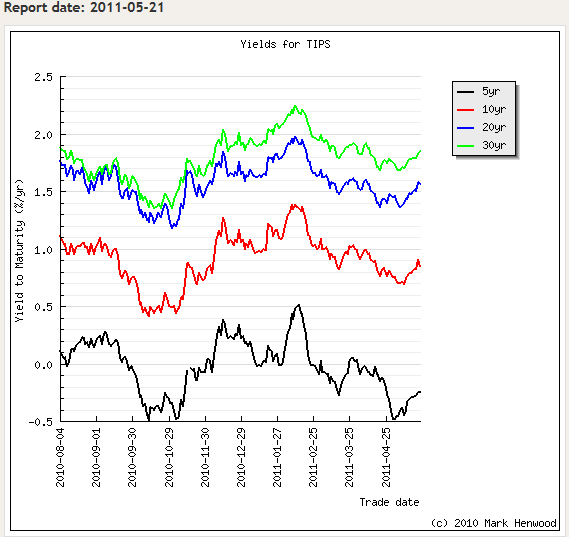
Bingo.  On April 12 the Treasury sold $14 billion in TIPS at a median yield of -.26% real with the highest rate paid of -.18%.  There is no doubt about it, the debt will be paid back with cheaper real dollars.   If the debt ceiling gets lifted, looking at the trends below the Treasury maybe able to sneak in some more of these “repressive” bonds.

TIPS return, last 200 days

Broader markets, as measured by the S&P 500 index have weathered the volatile start of May and notched a +0.7% gain as of May 10.   In contrast a broad basket of commodities [DJP] have fallen by 6.5% this month and now are  virtually breakeven for the year with a +.41% return (Bloomberg).

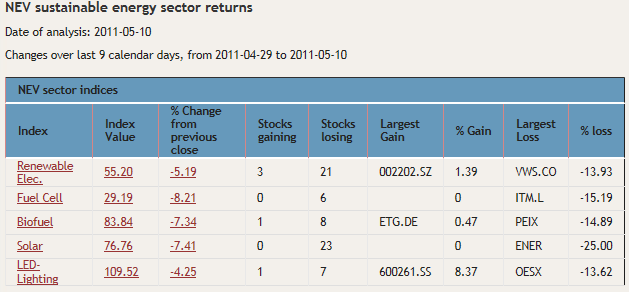
Clean energy funds are behaving like commodities in May.  As shown below, our indices are all down similar to commodities with only 5 stocks out of a total 70 stocks showing gains.


I’ve been watching Energy Conversion’s slide for a while so their appearance in the “Largest Loss” column for Solar caught my eye.   Unfortunately a 71% Q1 sales decline and a CEO departure  are patterns I’ve seen too often in the last few years.  I track coverage terminations now and ENER is inching closer to that joining that group.   Other solar stocks with a lot of European exposure could also bear watching.

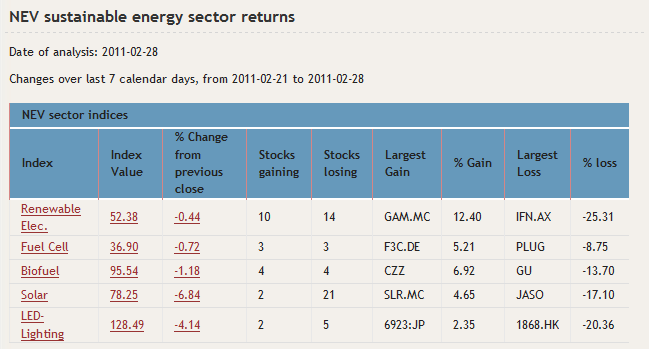
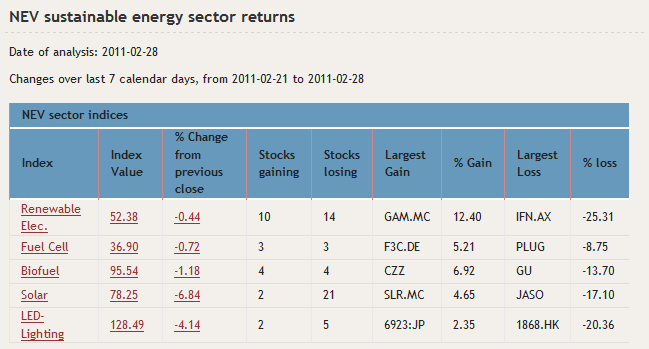
Over the last week broad markets have been volatile.  But clean energy defines volatile with negative 20% moves by a stock in the renewable electricity sector and in the LED-Lighting sector.

The current market concerns over European debt have hit clean energy hard.  YTD and over the last 365 days returns for all elements of the clean energy segment, with one exception, have been poor.  Excess returns (i.e. alpha) have been negative across the spectrum except for the LED technologists.  

I identified a group of companies in 2008 that were pursing LEDs as their primary business.   Their businesses seem to be growing and of all the clean energy sector I track they are the only ones with positive excess return over the S&P 500. 

Despite popular conceptions that LEDs are significanly more efficient then CFLs, their form factor, ruggedness, and longevity are translating into successfull products.  And successful products are what create value for longterm investors.   Just look at Apple where the iPhone is now over 40% of their business in just a few years!   I don’t think there is a breakthrough like that in the LED business but there is a pathway (efficiency improvement and cost reductions) that can make this lighting solution compelling.

Suprisingly, after losing 52% of its value from inception until the end of 2009, the iPath carbon GRN is leading all sustainable ETFs and mutual funds this year with a robust 1.4% YTD return. Airshares launched during this debacle and was unable to attract sufficient investment to stick around and stopped trading in August 2009. GRN’s performance is even more surprising given the generally downbeat news for cap and trade in the US driven, IMO, in large part due to the down economy, controversy over climate science, and downward pressure on fuel prices. Even California’s governor, a staunch supporter of cap and trade, is now talking about slowing down the state’s implementation of AB32.

But an even bigger hurdle for cap and trade (other than the horrendous complexity of these programs) is expanded supplies of reasonably priced natural gas. A little bit of substitution of coal by gas in electric generation and gasoline by gas in transportation may yield enough carbon mitigation to moot the cap and trade argument. With this kind of regulatory overhang, investing in carbon trading looks risky.

The correction started by the “Panic of 2008” continued with the broad US market falling until March and then rallying to finish out the first half of 2009 close to neutral.  The S&P closed 7/2 down 0.76%  YTD (excluding dividends). 

In general, sustainable energy stocks followed this pattern but were bid up more then the broader US market and posted some strong gains YTD as shown in the summary below.   In particular, Camino’s LIGHT index posted nearly doubled indicating this strategy may have potential.  See my previous post  about LIGHT and I’ll comment more on this later. 

Even with these gains, this volatile sector still has a long way to go to erase last year’s steep declines.

A once growing group of public companies continues to shrink.  We have discontinued coverage on Aventine Renewable Enery Holdings (AVR) due to its April 8, 2009 Chapter 11 filing.  It joins Panda Ethanol which was delisted after its Hereford subsidiary filed Chapter 11 on January 23, 2009.  

After these filing there only remain five (5) publicly traded, pure-play corn ethanol companies with market cap greater than USD 10 million.  Only Great Plains Renewable (GPRE) has a market cap greater than USD 50 million.

I recently wrote that I was seeing a fair amount of deliquencies in OTB BB companies.  

Four of the companies we track have now been moved to the Pink Sheets due to deliquencies in filings before the SEC.  Pacific Fuel Cell (PFCE.PK) went to the Pink Sheets on 12/19, Intrepid Technology (ITRP.PK) a biogas company, Earth Biofuels (EBOF.PK) a biodiesel company, and Essential Innovations (ESIV.PK) a geothermal heating company all were moved to the Pink Sheets on 12/24/08.

Companies moving from the OTC BB (we now track 39) to the Pink Sheets (we now track 27) are generally exhibiting declining value.   Our average OTC BB company has a market cap of USD 24 million where the average Pink Sheet company has a market cap of USD 4 million.   Buyer beware.