Archive for the ‘Market commentary’ Category

I’m seeing more activity then usual in delinquent OTC Bulletin Board companies.  In Camino’s last round of updates we found that Pacific Fuel Cell (PFCEE.OB),  Interpid Technology (ITRPE.OB), and Earth Biofuels (EBOFE.OB) have all been deemed delinquent in filings by FINRA.   While these companies can become current, investors in all three companies are in danger of losing all their investment. 

For those following our FCELL and BIOFUEL indices, it’s no surprise that investors in these two sectors face huge risks.  OTC companies face even steeper hurdles in a falling energy market.

Equities and commodities all fell during the week ending November 14th.  US REITs were particularly hard hit (RWR -18.5%).  For a complete summary visit our returns page. 

Sustainable energy also fell sharply with only 10 companies in our indices advancing.

SOLAR has experienced continuted high volatile with a variety of downgrades occuring during the week.    On Wednesday the index hit its 52 week low and closed the week down 74.5% YTD.  

This huge adjustment has left  the market cap of our SOLAR index shrinking to USD 33.4 billion from a peak of over USD 110 billion.   Some of the US traded companies, Yingli (YGE), JA Solar (JASO), SolarFun (SOLF), Trina (TSL), and Canadian Solar (CSIQ), are trading below book value with trailing PE ratios ranging from 4.6 – 6.5. 

These price levels reflect a very negative outlook for profitabilty and growth at the companies.    The negative outlook is stemming from concerns about sales levels,  margins, and negative currency exchange movements.   

Some data is coming out allowing us to assess the current valuation levels.  In its conference call this week JA Solar (JASO) reduced its sales forecast in 2009 to between USD 1.5 – 1.7 billion and EPS to USD 0.90.   These numbers reflect a huge 75+% sales growth over expected 2008 sales of USD 849.5 – 878.9 million and a forward PE of 3.1 on Friday’s close.   Sunpower also lowered its guidance for 2008 to EPS of USD 1.68, a forward PE of 15.2 on Friday’s close.   

Mark has a long position in JASO.

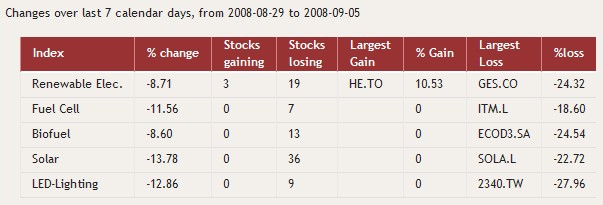
Toting up the results of the last amazing seven trading days, board markets and commodities are all down. 

Not surprisingly, the high growth sustainable energy sector declined even more with all indices falling sharply with losers outnumbering gainer by 10 to 1.   With their stock prices highly leveraged based on growth expectations, these stocks are experiencing their own type of “de-leveraging”.  

Over the last 300 days the Solar index beta vs S&P 500 has been has been 1.0.  In the last 30 days beta has increased to 1.2 as the index is increasing driven by broader market concerns.   Until broad market volatility subsides, I expect the larger sustainable energy strategies to be strongly influenced by the overall financial picture.  This means big swings in individual stocks and related indices.

Capping a crazy week, broad markets end up, while commodities retreated slightly.

Broad market comparables

Camino’s indices ended the week mixed amid highly volitile trading. 

In Biofuels, we again saw the potential for huge losses driven by poor risk management practices applied to hedging strategies. Read more here. Veresun (VSE) dragged the Biofuels strategy down for the week with a 67 % decline. This is after a a 50% bounce the stock received following it’s announcement it was reviewing “strategic alternatives” in the wake of its hedging loss.

On the up side LED-Lighting’s Cree (CREE) capped its strong week with an upgrade. Oppenheimer’s analyst apparently thinks light-emitting diodes are being adopted as a mainstream lighting product. This is a continuing demonstation of the influence of analysts.

I like LEDs. They last a long time (5x a CFL), they have a cool form factor, they don’t use mercury, they are rugged, they are dimmable, and they produce very nice light. Unfortunately, commercial LED products are no more efficient then CFLs and currently cost 20 times as much. Their long life doesn’t yet offset this high cost. Given time I expect them to penetrate more lighting applications but we are not there just yet for mainstream use. I’ll get excited when their cost start to fall significantly and approach no more the 5x the cost of a CFL.

Mark is the founder of Camino Energy, an information provider specializing in globally traded sustainable energy stocks.

Broader markets were mixed for the week.   The S&P 500  (+0.8%), US REITs (+2.7%),  and EAFA (+1.6%) all rose.   Emerging markets fell (-1.1%) and as did the basket of commodities we monitor (DJP -2.0%) 

Sustainable energy stocks weren’t mixed and fell sharply across the five strategies we track.  

week ending 9/12

Camino Energy indices

Coupled with the sharp drop we reported for week ending 9/5,  these strategies have declined between 13% and 18% (in USD terms) for the month of September.
.
In our view sustainable energy stocks are suffering declines driven, in the most part, by macro factors and not by individual company performance.  In the case of Solar, 32% of the index market cap is from companies headquartered in China.  In September the Shanghai Composite index has declined 13.3%    Another 43% of the Solar index is from companies headquartered in the Euro zone which has currencies declining against the dollar and is facing concerns about an economic slow down.   Add to the European angst the concerns regarding the US financial sector and we expect a reduction in the flow of funds into hedge funds and hence growth companies.  
.
The decline is commodities is also changing the perceived risk/reward perspective for investing in sustainable energy companies.   Analysts like Caylon’s  George Kotzias are saying “We believe a change in the perception of the current energy markets brought on by falling oil prices has led investors to believe that there is less of a need for solar energy”.   And the decline in commodities prices isn’t a result of a sudden spurt in new supplies but rather results from declining demand resulting from slowing economic activity. 
.
Slowing economic growth, concerns about the ongoing rational for sustainable energy, and weak financial markets seem to be selectively impacting the high growth, energy price driven sustainable energy strategies.  The result last week was 66 stocks declining and only 22 stocks advancing.   Until these underlying large scale factors turn, it looks like these stock may continue to languish.   
  

Author: Mark Henwood

Emerging markets (EEM -7.7%),EAFA (EFA -6.5%),and commodities (DJP -5.8%) drop sharply also.     

With only 3 of the 87 companies in Camino’s indices rising, this week ranks as the worst one week period since we started our commentary earlier this year.

And the underlying news, for instance in Solar stocks,  wasn’t too bad:

  • LDK Solar inks contract with Japanese company (9/5)
  • Suntech selected for 1 MW solar system (9/4)
  • Yingli inks contract with Fire Energy (9/4)
  • Canadian Solar inks supply contracts with GCL (9/3)

Solar stocks, and other strategies, are being swept up in broader market trends, including declines in oil prices.   While Solar generally exhibits moderate correlation with oil (.22 price correlation  over the last 365 days), in the last two weeks Solar has move closer with oil (.47 correlation).  

For the year, investors in sustainable stocks are now deep underwater.

With the sector’s high volatily and negative returns I wouldn’t be surprised to see funds in ETFs and mutuals start to decline.   That said, bargin hunting should start to pick-up, particularly for companies where sales aren’t linked tightly to overall market conditions. 

Mark is the founder of Camino Energy, an information provider specializing in globally traded sustainable energy stocks.

by Mark Henwood

Emerging markets, EAFA, and the US market (S&P 500) were again little changed on the week, commodities (DJP) fell 1.7%.

Sustainable energy stocks have exhibited significant volatility in past weeks but were relatively unchanged this week.  The exception was the fuel cell sector.

Fuel Cells were off for the week with the decline primarily driven by FuelCell Energy’s (FCEL) quarterly numbers.  The company reported increased revenue and increased losses.  The company has proven that if you sell more product at a loss you lose even more.  That said, management believes they are making progress in improving their cost/revenue ratio down to 1.5 in the next quarter and toward gross margin breakeven in the later half of 2009.  This means the earliest possible date for the company to show a profit is in 2010. 

Investors reacted by driving the stock down 18% for the week.  It’s hard to see an earnings growth tragectory starting in 2010 that justifies a USD 500 million market cap when current backlog is USD 100 million and production capacity is just 30 MW per year. 

Mark is the founder of Camino Energy, an information provider specializing in globally traded sustainable energy stocks.

Author: Mark Henwood

Emerging markets, EAFA, and the US market (S&P 500) were little changed on the week, commodities (DJP) rose 2.8%.  Sustainable energy stocks created some excitement but overall were mixed:

Solar raced ahead for the week rising 9.5% driven by a variety of positive developments.  Three of the index components China Sunergy (CSUN), Suntech Power Holdings (STP), and Rensola (SOLA.L) all rose over 25% for the week.

On the cost side silicon supplies are expected to increase in 2009 resulting, according to Suntech Power Holdings (STP), in a potential price drop of up to 20%.  This may allow margins to increase while lowering the cost of the final product. 

Demand continues to be strong with expectations that Italy, Germany, and other countries will offset any reduction in the Spanish market.  Demand seems to also be growing for larger scale plants with announcements for a 10MW plant by Yingli (YGE) and an 800 MW project by Pacfic Gas and Electric in Calornia. Note that this one project is larger than the annual production capacity of most solar companies. Solar companies are also executing well with China Sunergy (CSUN) leading the way with an earnings suprise this week of 125% which drove its 29.%5 increase for the week.  The triple play of expected lowering of costs, strong demand, and good financial execution created over USD 9 billion in increased market cap. 

Mark is the founder of Camino Energy, an information provider specializing in globally traded sustainable energy stocks.

Author: Mark Henwood

Emerging markets, EAFA, and commodities (DJP) fell while the US marketS&P 500) was flat. 

While Biofuels is the forth largest strategy behind Renewable Electricity, Solar, and LED-Lighting it highlighted a all too familiar risk for energy producers.  Many energy producers seek to reduce their risk associated with volatility in commodity prices by entering into hedging strategies.  The key point of these actives is to reduce risk, not profit from speculative positions.  After all, the largest, professionally managed financial institutions are proof even the pros get burned by speculation and I certainly don’t want any sustainable energy companies I investing in engaging in speculative postions.

Apparently, even engaging in hedging involves a certain amount of skill.  If management doesn’t get it right the hedging strategy can wipe out the value of a company faster than the worst operational decisions.  BioFuel Energy (BIOF) is a case in point.  On Tuesday the company opened at USD 2.60/share.  After reporting at 12:46 pm that it had insufficient current liquidity to cover USD 46 million in hedging losses on corn contracts, roughly equal to its market value, the stock started plunging, 64% to close at USD 0.94/share.  While the stock rebounded some late in the week, shareholders lost 38.5% of their value for the week.  Coming after Aventine’s (AVR) February problems with the not so safe auction rate securities, I hope management of biofuel companies devote enough attention to their financial dealings to avoid crises.

Mark is the founder of Camino Energy, an information provider specializing in globally traded sustainable energy stocks.

Author: Mark Henwood

Emerging Markets and commodities fell while US markets rose.  The dollar strengthened 3.6% against the Euro.


The three largest strategies, Renewable Electricity, Solar, and LED-Lighting all declined against a backdrop of a stronger dollar.  With 45% of both the Solar and Renewable Electricity Indices priced in Euro’s or Euro zone currencies the weekly decline was driven to some degree by currency movements.  Some other factors affecting the week included an analyst upgrade (CREE +13.0%) and concerns about polysilicon supply affecting 2009 earnings (YGE -12.9%). 

Mark is the founder of Camino Energy, an information provider specializing in globally traded sustainable energy stocks.