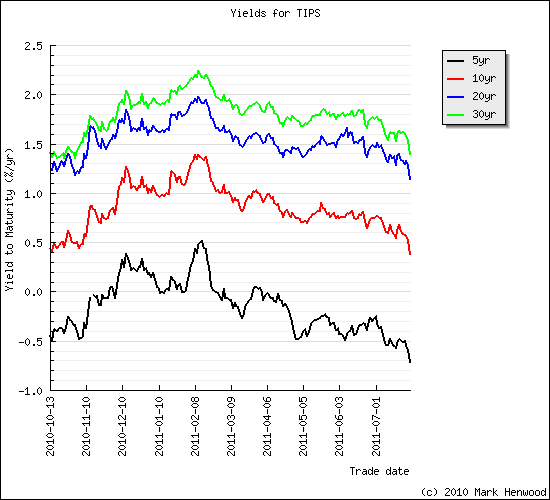
Not only have yields declined on nominal US bonds but TIPs yields have hit all time record lows. Five year TIPS now yields minus 0.84% (-0.84%) and the ten year TIPS yields zero. That means the real rate of return on a 10 year AA+ rate security, with no inflation risk, is zero. For taxable investors the real return is, of course, negative.
That said, the distortions continue to abound with the yield of AAA munis exceeding US Treasuries on all maturities up to 20 years. When I compute the AAA / AA+ after tax yield curve munis come out ahead in all time buckets.
Posted by Mark Henwood on August 9, 2011 at 10:15 pm under Uncategorized.
Comments Off on US downgrade supports TIPs and Treasuries.
The chance of the US defaulting on its obligations is still hanging on the balance of tough, dug in negotiations in Washington. But the yields on US Treasury bonds have continued to fall. Apparently these bonds are still considered a safe haven. With falling nominal bond yields, and with 5 year inflation expectations still in the 2% range, the real yield on 5 year TIPS hit another record low today at -.72%
Time for a quick 5 year TIPS issuance.
Posted by Mark Henwood on July 29, 2011 at 3:51 pm under News.
Comments Off on Debt standoff lowers 5 yr TIPS yield to a record low.
The 5 year TIPS hit a record low of -.54% on July 12 and 13 (http://www.treasury.gov/resource-center/data-chart-center/interest-rates/Pages/TextView.aspx?data=realyield).
For individuals investing in fixed income in taxable accounts here is what I’m looking at when I face a decision to purchase a high quality bond right now. Let’s assume inflation is estimated by the breakeven inflation rate which in the last few days has been running right around 2.0%.
If I invest in a 5yr TIPs, and I’m paying AMT my after tax return will be roughly (2% – 0.54%) * (1-.28) =1.05% or a -0.95% after tax return real return. Note that I neglect state income tax which is not levied on Federal bonds.
Another high quality alternative is a triple tax exempt AAA rated muni bond. These are available at roughly 1.3% yield to maturity resulting in a -0.7% after tax return real return. Better, but still dismal for fixed income investors.
While I’m watching these yield curves hit bottom I wasn’t surprised to see the Treasury is auctioning new TIPS this week. My only surprise was they are offering 10 year TIPSs that have a positive real return. As a tax payer I was hoping they would sell 5 yr TIPS at the absolute best historic price ever.
Is the 25 basis point advantage of the muni enough to overcome the risk that inflation is greater than 2.0% ? To help answer this I computed that if inflation was 2.35% over the five year period the return on the muni and the TIPS would be equivalent. Would I pay 25 bp to insure against inflation exceeding 2.35% …. probably a bargin.
Posted by Mark Henwood on July 16, 2011 at 9:39 pm under Analysis.
Comments Off on TIPS yields hit another record low.
I like the idea of solar PV. It works, it fits in. But for investors it’s like riding a bull in an arena because solar is still highly dependent on governmental support. When the support weakens watch out. Here are some examples.
First March 10, 2011 Energy Conversion’s CEO [ENER] reported that a dramatic and abrupt shift in the French and Italian solar incentive structures has impacted our business and that the changes may impact as much as 50% of this quarter’s forecasted revenue”. The next day ENER promptly lost 21.5% of its market value.
Next, Renewable Energy Corporation [REC.OL] succumbed to the chill blowing through the solar energy market on May 24, 2011 with a plan to cut output and lay off 500 workers, sending its shares tumbling. The maker of wafers, cells and modules for the solar industry also warned second-quarter results would be much weaker than the first three months. The solar industry — which depends on government incentives — has been hit by changes in subsidy legislation in Germany and Italy, the world’s No. 1 and No. 2 markets. Its shares were down 14 percent at 8:19 a.m. EDT while Oslo’s main index was up 1.0 percent.
Most recently, PV Crystalox Solar [PVCS.L] announced on June 28, 2011 that, as a result of the widely reported adverse PV market conditions experienced in recent weeks, shipment volumes in the first half of the year will be slightly below the guidance of 210-225 MW given in their Interim Management Statement on 19 May 2011. Of more concern were their statements about strong downward pressure on prices the hint the Group may incur an operating loss in the second half. The company concluded its announcement with a warning that it may not pay a dividend in 2011. The market promptly rewarded these announcements with a 41% decline in its stock price.
Posted by Mark Henwood on June 28, 2011 at 4:28 pm under Market commentary, News.
Comments Off on Subsidy woes continue.
Sacramento is working hard to become a recognized leader in cleantech. For years the region has had a Clean Energy Showcase which has attracted upwards of 800 attendees in the last two years. Not bad for a regional event! Our new mayor, Kevin Johnson, is also a clean energy proponent through his “Greenwise” initiative.
Today the mayor sponsored a meeting where Lisa Jackson, Administrator of the U.S. EPA was the speaker. Ms. Jackson is a refreshing speaker and in response to a question from the audience she made two very important comments regarding shale gas. First, she is now being advised there is a 200 year supply of gas from shale oil. This is very significant because it will fundamentally change energy economics in the electric sector and potentially in other areas. Her second key comment was there are no known cases of drinking water contamination from the fracking operations. Other than what I consider to be normal requirements to manage the water used in fracking , if there isn’t really a problem with the fracking operation itself then the potential for shale can be realized.
Why is this important? Gas competes with the variety of wholesale renewable electricity technologies. And with cheap combined cycle plants (super efficient, super reliable, super low emission, much lower carbon output vs coal, reasonable cost) natural gas is a formidable competitor. This will benefit the turbine suppliers (like GE, Siemans), the independent generators (like Calpine, Dynergy), and other firms like Clean Energy Fuels [CLNE] and GreenMan [GMTI.OB]. Coal producers (including all the companies in the Van Eck’s coal ETF KOL), on the other hand, obviously recognize the threat and are advertizing extensively touting the benefits coal.
Posted by Mark Henwood on June 13, 2011 at 10:23 pm under News.
Comments Off on Shale gas – large quantity, low impact.
While the first TIPs were issued by the Treasury in 1997 it wasn’t until 2003 that the Treasury Department started making available daily composite yields for TIPS. Yesterday had the distinction of having the lowest yield in the 8 year history of the 5 year TIPs at -.490853%. With the 5 year Treasury at 1.55% the Breakeven Inflation (BEI) is 2.04% over the next 5 years, not a particularly high expectation after the past few months of media coverage of commodity price increases.
For US individual taxable investors fleeing to the safety of Treasuries and paying 28% AMT tax, they can expect to lose .9% per year against inflation as the price of safety. This distorted fixed income market is tough to navigate and looks to continue for a while. I wouldn’t be surprised to see more new TIPS issuances with the Treasury seeking to take advantage of the opportunity to pay back debt with cheaper dollars.
Posted by Mark Henwood on June 9, 2011 at 12:10 pm under Analysis.
Comments Off on Financial Repression … TIPS yields hit record low.
For those who are interested here is a list of all mainland Chinese headquartered companies listed on US exchanges that are tracked in NEV’s database of sustainable companies:
|
| Company |
ticker |
exchange |
IPO yr |
| China Ming Yang Wind Power Group Ltd. |
MY |
NYSE |
2010 |
| China Intelligent Lighting and Electronics, Inc. |
CIL |
AMEX |
2010 |
| Daqo New Eneryg |
DQ |
NYSE |
2010 |
| JinkoSolar Holding Company, Ltd. |
JKS |
NYSE |
2010 |
| China Hydroelectric Corporation |
CHC |
NYSE |
2010 |
| China Wind Systems, Inc. |
CWS |
NGM |
2007 |
| Gushan Environmental Energy Limited |
GU |
NYSE |
2007 |
| Yingli Green Energy |
YGE |
NYSE |
2007 |
| LDK Solar Co. LTD |
LDK |
NYSE |
2007 |
| China Sunergy Co. |
CSUN |
NasdaqNM |
2007 |
| China Clean Energy Inc. |
CCGY.OB |
OTC BB |
2007 |
| JA Solar Holdings Co., Ltd. |
JASO |
NasdaqNM |
2007 |
| Hanwha SolarOne Co., Ltd. |
HSOL |
NasdaqNM |
2006 |
| Trina Solar Limited |
TSL |
NYSE |
2006 |
| Canadian Solar Inc. |
CSIQ |
NasdaqNM |
2006 |
| Suntech Power Holdings Co. |
STP |
NYSE |
2005 |
| China BAK Battery Inc. |
CBAK |
NGM |
2005 |
| Advanced Battery Technologies, Inc. |
ABAT |
NCM |
2004 |
Posted by admin on June 3, 2011 at 11:08 pm under Analysis.
Comments Off on Chinese companies listed on US exchanges.
The WSJ reported today that the SEC is investigating some accounting firms involved in audits of Chinese companies that subsequently engaged in reverse mergers to become listed on US exchanges. It’s good the SEC is investigating these practices, after all we need all the protection from fraud we can get. Apparently the NASDAQ also feels additional action is necessary since on April 18, 2011 it filed a proposed rule change with the SEC to add additional controls.
Many reverse merger companies are listed on OTC exchanges. As I’ve mentioned before these exchanges are fraught with risk for individual investors and the SCE investigation is just another reminder of the dimensions of these risks.
Posted by admin on June 3, 2011 at 10:59 pm under Market commentary.
Comments Off on SEC investigates reverse mergers.
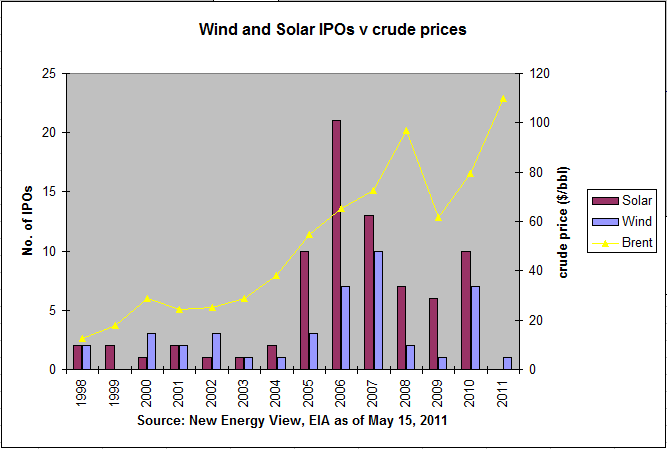
Of the 340 sustainable energy companies I track, 64% of the market value is in the solar PV producers and the wind technologists and wind farm operators. Everything else, from ethanol producers, LED technologist, to advanced battery makers accounts for 36% of the market. Wind and solar compete in the electric generation market which is dominated by coal, nuclear and natural gas power stations. Crude oil prices only indirectly affect the markets for wind and solar by dragging along natural gas prices and influencing policy makers to provide subsidies to wind, solar, and everything else “clean energy” when oil prices go up. And these subsidies eventually set the stage for the entry of more public companies.
So what is happening recently? Oil prices are on their way to setting an all-time record high on an annual basis. A few years back this translated into IPOs but examining the chart below that’s not happening, at least so far, with this year’s run up in oil prices.
Solar and Wind IPOs by year
Collectively the lingering hang-over from the Panic of 2008, a maturing of the industry, and a decrease in subsidies in some markets has clearly reduced the opportunities for companies to enter the public markets. That said, the existing companies seem to have gotten stronger compared to a few years back and if they are able to maintain the favorable governmental treatment they should continue to increase their market share.
Posted by admin on May 25, 2011 at 12:27 am under Analysis.
Comments Off on Wind and Solar IPOs slow down.
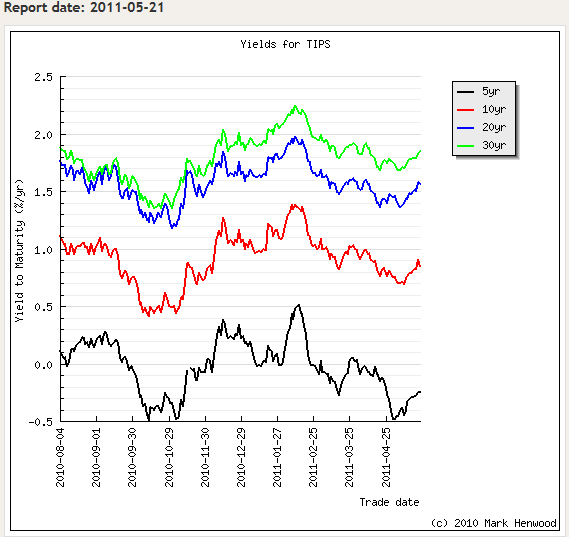
Today Jason Zweig wrote in the WSJ about the various worries that government bond holders have. Zweig’s biggest worry isnt’ default, but what economist Carmen Reinhart of the Peterson institute of International Economics calls “financial repression” or the use by governments of harsh methods to dig out from under burdensome debts. One example would be keeping short-term interest rates below the level of inflation so a government can pay off debt with cheapening money.
Bingo. On April 12 the Treasury sold $14 billion in TIPS at a median yield of -.26% real with the highest rate paid of -.18%. There is no doubt about it, the debt will be paid back with cheaper real dollars. If the debt ceiling gets lifted, looking at the trends below the Treasury maybe able to sneak in some more of these “repressive” bonds.
Posted by admin on May 21, 2011 at 9:37 pm under Market commentary.
Comments Off on Financial Repression..fretting about bonds?.