I just took a look at the universe of 89 solar stocks in my database.  At the end of the Panic of 2008 only 23 companies passed my screens for index tracking.  Running the screens today, I pass 38 companies, a dramatic increase in investable firms.

The screens are typical for creating an index:  the energy source is solar, the product is PV related or electricity, the market cap is greater than  USD 150 million, over 50% of the business is from solar activities, the firm trades on a recognized (non-OTC) exchange for over 6 months, at least .25% of the shares trade on average over a three-month period with a daily value of at least USD 250,000.

I also eliminate companies from consideration that were previously tracked but have fallen below USD 100 million in market cap.  The four firms that failed this test are Energy Conversion [ENER], Solon [SOO1.F], Solar-Fabrik [SFX.F], and Evergreen [ESLR].

There are  4 new firms I track in the solar sector with market caps greater than USD 1 billion.   The largest, GCL-Poly [3800.HK]  is nearly as large at First Solar [FSLR].  The three other new billion club members are SMA Solar [S92.DE], GT Solar [SOLR], and Hanan Xindaxin [300080.SZ].

For a complete list register on the NEV research site and look at the Solar sector report.

I’m seeing some interesting shifts in the solar sector.  With 67 solar IPOs from 2005 through 2010 (where there were 10),  there have been no IPOs in 2011.   We are also seeing an increasing number of firms entering the wholesale power generation business and cell prices have fallen.  (It’s a lot easier to sell in volume with 1 – 10 MW wholesale projects versus 5 kW end-use projects).  The industry is maturing, but still very dependent on governmental support as evidenced by Energy Conversion’s woes in March when a shift in subsidies in France and Italy crushed revenue.   In North America, the shift to wholesale generation puts PV in direct competition with super-efficient combined cycle alternatives burning shale gas.  That said, the downward march in prices, and the larger stable of companies represents significant progress in the sector.


Broader markets, as measured by the S&P 500 index have weathered the volatile start of May and notched a +0.7% gain as of May 10.   In contrast a broad basket of commodities [DJP] have fallen by 6.5% this month and now are  virtually breakeven for the year with a +.41% return (Bloomberg).

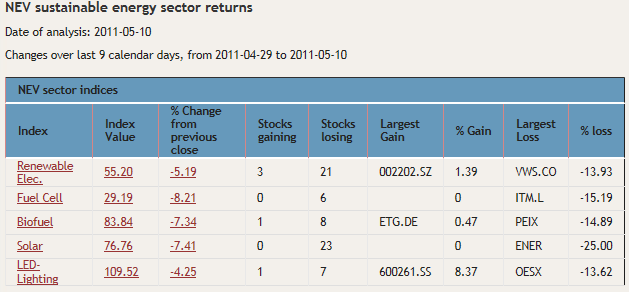
Clean energy funds are behaving like commodities in May.  As shown below, our indices are all down similar to commodities with only 5 stocks out of a total 70 stocks showing gains.


I’ve been watching Energy Conversion’s slide for a while so their appearance in the “Largest Loss” column for Solar caught my eye.   Unfortunately a 71% Q1 sales decline and a CEO departure  are patterns I’ve seen too often in the last few years.  I track coverage terminations now and ENER is inching closer to that joining that group.   Other solar stocks with a lot of European exposure could also bear watching.

A few things have changed in the EV market, some good, some bad.   Here is the good news first.

In western US night time wholesale electricity rates continue to be very depressed.  This is a result of a combination of low cost natural gas (thanks to shale gas) and an extremely efficient generating fleet comprised of modern combined cycle plants which set electric prices almost all the time in the west.  The latest forecast for off peak prices in northern California (courtesy of www.weccterm.com)  is:

Quarterly forecast prepared5/3/2011, Off-peak prices
period        NP15 (Northern California)
2011-2      2.3 cents/kWh
2011-3      3.9 cents/kWh
2011-4      3.8 cents/kWh
2012-1      4.1 cents/kWh

With this low cost backdrop, the Sacramento Municipal Utility District (SMUD) has adopted a special PV rate schedule that has nighttime charging rates of 8.4 cents/kWh in the summer and 7.54 cents/kWh in the winter.  While I would like to see SMUD flow through the wholesale rates, their PV rate is below the national average electric rate and is supportive of PV economics.   Since each of these rates is available 6 months of the year I’ve used the average, 8.0 cents/kWh.

PV are also looking better due to higher gasoline prices..   As of now, the absolute cheapest regular gasoline available in the Sacramento area is $4.05 / gallon and the average is around $4.15 / gallon.    In my last analysis I was using $3.50 / gallon …. given the current situation of a declining US dollar and strong demand in emerging economies I think $4.15 / gallon is a reasonable benchmark for comparison.

Finally, as I reported earlier we are now seeing some larger players enter the charger market with GE claiming they will be able to offer a charger for around $1,000.   So I think a little decline in charger costs, to $1,750 is warranted.

Combining these changes I updated the comparison of the Toyota Camry and the Nissan Leaf.  For a 12,000 mile per year driver, the Leaf owner can recoup their higher initial cost in 4.1 years and if the owner drives the car 96,000 miles over 8 years the return on the initial higher cost is a solid 18%.

I like these numbers and the hedge the EV provides against gasoline prices.  Electric prices in the US have nothing to due with the price of crude oil…..hence the hedge.

Here is where the bad news comes in.  I talked to my local Nissan [NSANY.PK]  dealer and found the they were still working on delivering the intial 20,000 Leafs allocated to the US.  Apparently the best I can do is to register on the Nissan site to get notified when I can reserve a 2012 model and get delivery sometime in 2012.   So there may be a horse race betweenwhen the Ford Focus EV [FORD] and the Toyota RAV EV [TM] are released and when Nissan is able to actually deliver.  Nissan’s slow delivery make me wonder if there is a technology problem with the system or the batteries?


While I track 53 companies that produce some form of biofuel, most of these companies don’t pass a basic screen for investment and hence inclusion on NEV’s BIOFUEL index. For a specific stock to be included the company has to (1) generate a material portion of its revenue, generally over 50%, from sustainable energy activities, (2) have a total market capitalization (not float adjusted) of at least $100 million USD at the time of inclusion, (3) trade on a recognized exchange for at least 6 months, and (4) have adequate trading volume for reasonable liquidity. We exclude companies that are in bankruptcy or are publicly traded project finance vehicles.

Until recently the group that passed these screens had shrunk to just 8 companies. But one of the companies that I had been forced to remove a few years ago has staged a comeback and now has nearly 500 million USD in market cap. As a result we have expanded the index to include Green Plains Renewable Energy [GPRE] as of 4/26/2011.  Amyris [AMRS] is a candidate for inclusion but currently is an R&D stage company and our experience has shown that companies at this stage present additional risks that make them speculative for investment purposes.

Registered users of New Energy View can see the complete list of companies by going to the Research > Company Search  tab and filtering for companies producing biodiesel, biofuel, biogas, biomass, ethanol, methane, or plant oil.

In a previous post on the California R/C solar market I identified 5 factors needed to continue the growth in solar installations.    Topping the list was “continuation of federal and state  incentives which drive down the cost of installs significantly (California incentives will grow to around $600 million per year in California by 2015, this is real money)”  .

Yesterday Energy Conversion’s CEO  [ENER] reported that “a dramatic and abrupt shift in the French and Italian solar incentive structures has impacted our business” and that the changes  “may impact as much as 50% of this quarter’s forecasted revenue”.   On Friday ENER promptly lost 21.5% of its market value.

Policy makers don’t have a lot of choices on how to make a dent in fossil fuel consumption and solar is certainly part of the picture.   But policy makers also face financial pressures that make renewable policies vunerable due to their costs vis-a-vis doing nothing.   In this case investors stand to be the losers in the balancing act.

Disclosure: the author has no position in ENER.

Three more companies dropped out of our database.  Consolidated Biofuel (CSBF.PK), Turbodyne Technologies (TRBD.OB), and US Energy Systems (USEYQ.PK) have all ceased trading.  Consolidated was in the biodiesel business, Turbodyne was trying to leverage an electric turbocharger, and US Energy developed small scale cogen projects.    Apparently none of these strategies were able to gain traction.     They are just a reminder that investing in the OTC markets is fraught with a significant risk of the complete loss of an investment.

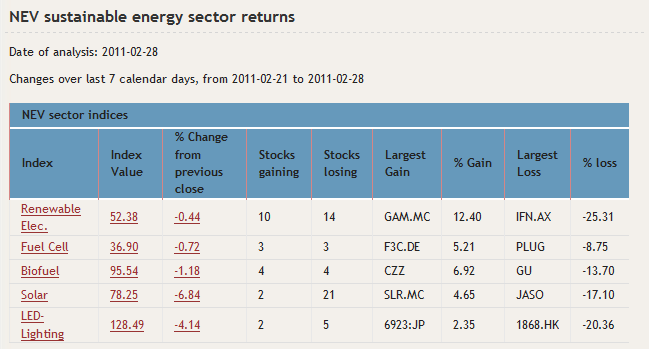
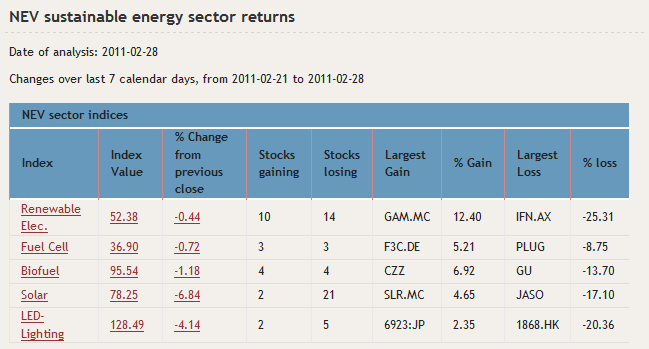
Over the last week broad markets have been volatile.  But clean energy defines volatile with negative 20% moves by a stock in the renewable electricity sector and in the LED-Lighting sector.

In my previous post I wrote that we will use EVs like we use cell phones.   After driving our cool EV in the day, we’ll plug it in at night and charge it up for the next day.   Put yourself in the EV seat and this seems a workable scenario.    I really don’t see how I would use public charging very much or, frankly, ever change out a battery.

Apparently other players are coming to the same conclusion.   On Feb 24, the WSJ reported that GE, Siemens, and Eaton all believe that EV owners will soon be buying chargers for their homes.    GE says it is planning to sell it’s home charger for about $1,000 which will help EV economics.  I my previous analyses I’ve assumed an installed cost of  $2,000 and I may now be able to lower this a bit.  With low cost nighttime electricity and higher gasoline costs EVs are looking a little better.

What isn’t looking better is public EV charging stations.  Apparently NRG Energy Inc. is planning to spend $10 million to install 100 chargers in Houston by 2011.  Let see, that’s $100,000 per charging station?   If they announce any more of these programs sell NRG Energy  [NRG].

Calpine (CPN) is a great company.  Occasionally I see Calpine listed when geothermal companies are being discussed because of their 725 MW of geothermal at the Geysers.  But for sustainable energy investors its exposure to renewable technology is too small to include Calpine in an investment strategy.   Of their 28,549 MW of capacity, only 2.6 % is renewable with the balance being combined cycle or simple cycle peaking turbines.   As a result I’m removing coverage of Calpine from my database.

That said, their emphasis on natural gas fired combined cycle plant may payoff big.  Continued moderation in natural gas prices driven by the shale gas boom, low capital costs, high generation efficiency, and low air and carbon emissions present big opportunities for combined cycle developers.  Not only is it a strong candidate to supply new MWs, but combined cycles may replace the aging coal fleet at lower cost then air and carbon capture retrofits.   IMO this is one of the best carbon reduction opportunities in the near term.

After posting my December 6 article about EVs Economics are getting interesting I’ve received numerous comments and I’ve had discussions with utility executives and board members. Based on this input I’ve refined the economic analysis of the Leaf vs. Camry and I’ve addressed a potential regulatory Catch-22 concern that utilities might run up against if they aggressively go after the EV market.

Refinements


The more I discuss EV usage, and considering how I would use an EV, I’m increasingly convinced the 100 mile class of EV will be used like a cell phone. At the start of the day, the EV is unplugged and driven. At night, the car is parked in or near its home garage and charged up. The whole discussion about public charging, or changing out batteries, will be irrelevant. These vehicles will be short range around town cars. For drivers that go on long trips the EV won’t be used, the owner’s other, gas power car, will be. Range anxiety can be addressed when necessary with a little high cost topping off from a 120 VAC outlet at the destination.

 Since the car will be charged at night this represents an opportunity for utilities to market power in a new way. Namely the utility can offer to sell electricity via a 220 VAC outlet at very low cost during the night off-peak power block period. During the rest of the day, power would be unavailable from the 220 VAC outlet and a customer would have to rely on 120 VAC charging. This avoids potential overloading of distribution transformers and aligns a cheap tariff with cheap power while placing no cost burden on other utility customers.

As part of updating the economics I double checked wholesale market outlook (thanks to www.weccterm.com) and found the outlook continues for very low off-peak prices that easily allow provision of electricity to the EV at 5 cents/kWh and allows for some utility margin:

Quarterly forecast prepared 1/18/2010, Off-peak prices
period        NP15 (Northern California)
2011-1      2.9 cents/kWh
2011-2      2.5 cents/kWh
2011-3      3.6 cents/kWh
2011-4      3.7 cents/kWh

Previously I used 15,000 miles per year as the average annual mileage driven by Americans in a year. While the DOE/EPA Model Year 2011 Fuel Economy Guide bases its annual fuel costs on 15,000 mile per year, EPA’s transportation and air quality group peg the average miles driven at 12,000 miles per year. And the Federal Highway Administration shows drivers in the 20 – 54 age range averaging over 15,000 per year. Taking this all in I’ve decided to conservatively base the average analysis on 12,000 miles per year.

Some comments noted that EV will have lower maintenance costs than gas power cars. I think it’s fair to credit the EV with avoided oil changes. This isn’t a big factor but does improve the EV economics a bit.

I also used an estimated 10 cents/kWh for a nationwide average for retail electric prices. For the average charging analysis I’m now using 11.5 cents/ kWh which according to the EIA is the actual August 2010 nationwide average.

In my first analysis I included 10% losses in the charging equipment because I was in a hurry. This is probably a little high and I revised the loss figure to 5% consistent with losses in a couple of thyristors.

Previously I based my analysis on $3.50 gasoline. This still seems a fair estimate and I’ve continued to use it. Of course, if gasoline prices spike EVs will get a boost.

All these changes taken together erode the EV economics a bit but not enough to change my previous conclusion that EVs can be a hit given some creative utility rates. But at my current rates, I’ll wait on the EV, sigh.

Scenario                 Break-even years      IRR at 96,000 miles (8 years)
1  (5 cent/kWh)                 4.6                                14 %
2  (11.5 cent/kWh)            5.6                                 9%
3  (17.6* cent/kWh)         6.9                                 4%
* this is what I pay today to SMUD for each incremental kWh

EV payback

EV payback

The Catch-22
Many utilities, and certainly those in California, are facing Renewable Portfolio Standard (RPS) requirements. So if a utility added significant new load, say 50,000 EVs charging at 3kW at night, the utility would need to provide an additional 150 MW of power. In all likelihood this power would come from fossil sources, at least for some period of time. In the western US the marginal generating resource at night is almost always very efficient natural gas fired combined-cycle power (thank you again www.weccterm.com) . Essentially we would be running domestic natural gas through a high efficiency conversion and displacing imported crude or gasoline. But a utility may be penalized by RPS requirements for this very sensible activity – the Catch-22.

The RPS standards have been enacted in large part to address climate change resulting from burning fossil fuels. To test whether the RPS standards are counter-productive to their own purpose in the case of EV charging, I dove into carbon calculating.

I first calculated the annual pounds of CO2 the Camry would produce. Using EPA mileage, 12,000 miles per year, and the EPA’s CO2/gallon of gasoline figure, I computed the Camry would produce 9,502 lb/CO2 per year.

Next, to calculate the Leaf’s CO2 production, I adjusted the Leaf’s kWh consumption back to the generation level by adding back transmission system losses. Then I determined the amount of natural gas consumed using night time combined cycle heat rates of 7,500 Btu/kWh. Finally I applied EPA’s latest C-factors (including the 2 oxygens) for natural gas to compute the CO2 produced. The result: 4,049 lb/CO2 produced per year, less then one-half that produced by a gasoline engine.

This result makes sense: (1) combined cycle power plants, even after transmission and charging losses are really efficient, and (2) natural gas produces a lot less CO2 than an equivalent amount of gasoline.

The conclusion is straightforward, EV charging should be exempt from RPS requirements and the EPA should be gung-ho for EV charging. And at the end of the day I don’t see any way a utility will ultimately be penalized for encouraging EVs.