Author: Gary Simon
It appears the world has its first profitable fuel cell company. Smart Fuel Cell in Germany (F3C.DE) basically reached breakeven in Q2 08 and as revenues grow should show positive earnings in Q3 and Q4. Smart makes a direct methanol fuel cell, using a similar PEM membrane as the hydrogen-only fuel cells. Smart has reported its fuel cells are only 11% efficient, but are improving. How much they are improving has not been mentioned. Smart shows a trailing 12 month revenue of $23 million—not bad at all. Their results seem to show that indeed customers like a fuel cell with an easy-to-carry, compact and relatively easy-to-find liquid fuel, even if the efficiency is low. This stands in contrast to the hydrogen-fueled PEMs where finding the fuel is still a chore. Once a company in a new technology area begins generating positive cash flow, it has a war chest to erect barriers preventing others from entering its market. It will be interesting to see how Smart does on this score.
There are several direct methanol fuel cell companies with more efficient, maybe even better, technology. The question will be whether that matters in the face of a blocking move from a profitable competitor. Oorja Protonics (private) unveiled its direct methanol kw-class power pack for forklifts in the past quarter, and Mechanical Technology (MKTY) continues progress on its small methanol unit for portable devices. CMR Fuel Cells (CMF.L) in the UK similarly is continuing work on its 25 watt methanol unit.
A good example of a profitable business will likely lift the fortunes of other fuel cell companies and that could improve valuations. However, nothing will improve valuations like a good exit—early investors getting extravagantly rewarded through a popular public share or acquisition. The bubble in 2000 made some fuel cell company investors immediately wealthy, but that opportunity came crashing down when reality came no where near the hype. If there is to be another surge, it will have to be based on real results—from at least some companies. Hydrogenics (HYGS) and private company Altergy may be coming close to profitability soon. Altergy (hydrogen PEM fuel cells for telecom backup) is rumored to be preparing for an IPO next year. Maybe they will provide that big exit that will attract attention.
Unfortunately, another dramatic milestone was reached in Q2 08: The cumulative (multi-year) losses from the public fuel cell companies exceeded $4 billion. All the usual suspects continue to bleed cash—Fuel Cell Energy (FCEL), Ballard Power (BLDP) and Plug Power (PLUG). Those losses continue to put a damper on investor interest in the sector. FCEL’s results for Q2 08 were worse than expected, with a loss of $26 million and more importantly a ratio of cost to sale price of 1.68, actually up from 1.61 in Q1. Recall that a big question looming for FCEL is whether its success in sales (revenues doubled over last year) will bring them closer to or farther from breakeven. This quarter’s results showed worse than expected margins on increased sales.
It is still very likely there will be a significant shake-out in the next year. There are seven public and private companies currently officially in collapse—some through Chapter 11, some through liquidation, some through sale. Perhaps the most surprising to some was the announcement by Siemens-Westinghouse that its solid oxide fuel cell business was for sale. S-W probably spent hundreds of millions to develop this technology and probably the US Department of Energy tossed in hundreds more. This follows the move in the Spring of 2007 by General Electric to shutter its major solid oxide fuel cell shop in Torrance, California. While GE continues some technology research at its corporate R&D center in New York, it backed away from creating a commercial product. Maybe all this says is that the big-company approach to fuel cells isn’t working so well. Start-ups like Smart Fuel Cells show there is another way, especially by starting small with its 50 to 250 watt size systems.
United Technologies through its UTC Power unit is still one big company pursuing large fuel cells. It recently announced an award to supply 12 fuel cells of 400 kW each for the World Trade Center in Manhattan. This is the new unit slated to replace the 200 kW PC 25. UTC has sold over 270 of the PC 25 units to date, probably the most kWs of fuel cells sold in the world. However, UTC has not reported that the fuel cell division is profitable. The conventional wisdom is that the new 400 kW unit is UTC’s move to try to bring the division to profitability. That creates an interesting contrast to the “small is better” approach.
Gary Simon is a venture partner with Velocity Venture Capital in Folsom, CA. He is the CEO of Acumentrics and a board member of Jadoo Power. Both companies are deeply involved in commercializing fuel cells. Gary is also an advisor to Camino Energy.
Posted by Gary Simon on September 9, 2008 at 7:36 pm under Analysis.
Tags: BLDP, CMF.L, F3C.DE, FCEL, HYGS, MKTY, PLUG
Comments Off on Finally, a profitable fuel cell company!.
Author: Mark Henwood
Emerging markets (EEM -7.7%),EAFA (EFA -6.5%),and commodities (DJP -5.8%) drop sharply also.

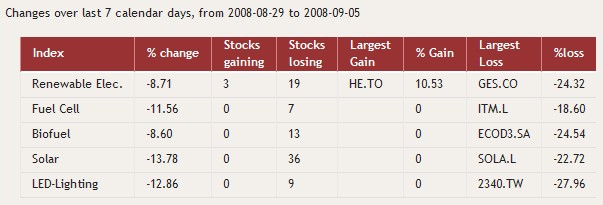
With only 3 of the 87 companies in Camino’s indices rising, this week ranks as the worst one week period since we started our commentary earlier this year.
And the underlying news, for instance in Solar stocks, wasn’t too bad:
- LDK Solar inks contract with Japanese company (9/5)
- Suntech selected for 1 MW solar system (9/4)
- Yingli inks contract with Fire Energy (9/4)
- Canadian Solar inks supply contracts with GCL (9/3)
Solar stocks, and other strategies, are being swept up in broader market trends, including declines in oil prices. While Solar generally exhibits moderate correlation with oil (.22 price correlation over the last 365 days), in the last two weeks Solar has move closer with oil (.47 correlation).
For the year, investors in sustainable stocks are now deep underwater.

With the sector’s high volatily and negative returns I wouldn’t be surprised to see funds in ETFs and mutuals start to decline. That said, bargin hunting should start to pick-up, particularly for companies where sales aren’t linked tightly to overall market conditions.
Mark is the founder of Camino Energy, an information provider specializing in globally traded sustainable energy stocks.
Posted by Mark Henwood on September 6, 2008 at 2:53 pm under Market commentary.
Comments Off on All sustainable energy stocks clobbered (week ending 9/5).
by Mark Henwood
Emerging markets, EAFA, and the US market (S&P 500) were again little changed on the week, commodities (DJP) fell 1.7%.
Sustainable energy stocks have exhibited significant volatility in past weeks but were relatively unchanged this week. The exception was the fuel cell sector.

Fuel Cells were off for the week with the decline primarily driven by FuelCell Energy’s (FCEL) quarterly numbers. The company reported increased revenue and increased losses. The company has proven that if you sell more product at a loss you lose even more. That said, management believes they are making progress in improving their cost/revenue ratio down to 1.5 in the next quarter and toward gross margin breakeven in the later half of 2009. This means the earliest possible date for the company to show a profit is in 2010.
Investors reacted by driving the stock down 18% for the week. It’s hard to see an earnings growth tragectory starting in 2010 that justifies a USD 500 million market cap when current backlog is USD 100 million and production capacity is just 30 MW per year.
Mark is the founder of Camino Energy, an information provider specializing in globally traded sustainable energy stocks.
Posted by Mark Henwood on September 1, 2008 at 8:41 pm under Market commentary.
Tags: FCEL
Comments Off on Relatively quiet week for sustainable stocks – except for Fuel Cells (week ending 8/29).
Author: Mark Henwood
Emerging markets, EAFA, and the US market (S&P 500) were little changed on the week, commodities (DJP) rose 2.8%. Sustainable energy stocks created some excitement but overall were mixed:

Solar raced ahead for the week rising 9.5% driven by a variety of positive developments. Three of the index components China Sunergy (CSUN), Suntech Power Holdings (STP), and Rensola (SOLA.L) all rose over 25% for the week.
On the cost side silicon supplies are expected to increase in 2009 resulting, according to Suntech Power Holdings (STP), in a potential price drop of up to 20%. This may allow margins to increase while lowering the cost of the final product.
Demand continues to be strong with expectations that Italy, Germany, and other countries will offset any reduction in the Spanish market. Demand seems to also be growing for larger scale plants with announcements for a 10MW plant by Yingli (YGE) and an 800 MW project by Pacfic Gas and Electric in Calornia. Note that this one project is larger than the annual production capacity of most solar companies. Solar companies are also executing well with China Sunergy (CSUN) leading the way with an earnings suprise this week of 125% which drove its 29.%5 increase for the week. The triple play of expected lowering of costs, strong demand, and good financial execution created over USD 9 billion in increased market cap.
Mark is the founder of Camino Energy, an information provider specializing in globally traded sustainable energy stocks.
Posted by Mark Henwood on August 24, 2008 at 8:18 pm under Market commentary.
Tags: CSUN, SOLA.L, STP, YGE
Comments Off on Solar posts big gain (week ending 8/22/08).
Author: Mark Henwood
Emerging markets, EAFA, and commodities (DJP) fell while the US marketS&P 500) was flat.

While Biofuels is the forth largest strategy behind Renewable Electricity, Solar, and LED-Lighting it highlighted a all too familiar risk for energy producers. Many energy producers seek to reduce their risk associated with volatility in commodity prices by entering into hedging strategies. The key point of these actives is to reduce risk, not profit from speculative positions. After all, the largest, professionally managed financial institutions are proof even the pros get burned by speculation and I certainly don’t want any sustainable energy companies I investing in engaging in speculative postions.
Apparently, even engaging in hedging involves a certain amount of skill. If management doesn’t get it right the hedging strategy can wipe out the value of a company faster than the worst operational decisions. BioFuel Energy (BIOF) is a case in point. On Tuesday the company opened at USD 2.60/share. After reporting at 12:46 pm that it had insufficient current liquidity to cover USD 46 million in hedging losses on corn contracts, roughly equal to its market value, the stock started plunging, 64% to close at USD 0.94/share. While the stock rebounded some late in the week, shareholders lost 38.5% of their value for the week. Coming after Aventine’s (AVR) February problems with the not so safe auction rate securities, I hope management of biofuel companies devote enough attention to their financial dealings to avoid crises.
Mark is the founder of Camino Energy, an information provider specializing in globally traded sustainable energy stocks.
Posted by Mark Henwood on August 18, 2008 at 10:37 am under Market commentary.
Tags: AVR, BIOF
Comments Off on Solar and LED-Lighting rise sharply, BioFuel Energy highlights risk and drags Biofuels down (week ending 8/15).
Author: Mark Henwood
Emerging Markets and commodities fell while US markets rose. The dollar strengthened 3.6% against the Euro.
 Â
Â
The three largest strategies, Renewable Electricity, Solar, and LED-Lighting all declined against a backdrop of a stronger dollar. With 45% of both the Solar and Renewable Electricity Indices priced in Euro’s or Euro zone currencies the weekly decline was driven to some degree by currency movements. Some other factors affecting the week included an analyst upgrade (CREE +13.0%) and concerns about polysilicon supply affecting 2009 earnings (YGE -12.9%).
Mark is the founder of Camino Energy, an information provider specializing in globally traded sustainable energy stocks.
Posted by Mark Henwood on August 10, 2008 at 9:26 pm under Market commentary.
Tags: CREE, YGE
Comments Off on Key sustainable energy indices and commodities fall, US markets rise (week ending 8/8).
The Solar index has been updated and rebalanced for a net gain of 2 companies to 36 constituents. Three companies were added: Solargiga Energy Holdings (0757.HK), Shenzhen Topraysolar Co., Ltd. (002218.SZ), and Solar Integrated Technologies, Inc. (SIT.L). One company, Spire Corporation (SPIR) was removed due to a decline in market capitalization.
The Renewable Electricity index has been updated and rebalanced. The index now contains 22 constituents reflecting the removal of Solar Millennium AG (S2M.DE) due to a decline in market capitalization.
The Biofuels index has been updated and rebalanced. The index now contains 14 constituents reflecting the removal of Nova Biosource Fuels, Inc. (NBF) due to a decline in market capitalization.
The Fuel Cell index has been rebalanced. There were no changes in constituents.
The LED-Lighting index has been rebalanced. There were no changes in constituents.
Posted by Mark Henwood on July 19, 2008 at 9:04 pm under Indices.
Tags: 002218.SZ, 0757.HK, NBF, S2M.DE, SIT.L, SPIR
Comments Off on PurePlay(tm) Indices updated effective July 18, 2008.
Even commodities fell this week with the broad commodity index tracked by DJP falling.
Sustainable energy stocks continued to show high volatility with several strategies suffering significant declines.

Posted by Mark Henwood on July 14, 2008 at 6:08 am under Market commentary.
Comments Off on Solar bucks market trends (week ending 7/11).
Two new European IPOs launched in June adding to the number of publicly traded solar and wind companies. The world’s forth largest wind producer, EDP Renovaveis (EDPR.LS) listed on the Lisbon Exchange on June 2, 2008. Solar inverter producer SMA Solar Technologies AG (S92.F) listed in Franfort on June 26, 2008. Both firms are now part of Camino’s ongoing coverage.
On the coverage loss side, one company was eliminated due to its acquision and one was discontinued due to bankruptcy.
The ASX formally suspended quotations for Babcock & Brown Environmental Investments (BEI.AX) on 5/16/08. Babcock & Brown Environmental Investments Holdings Pty Ltd (Babcock & Brown) has acquired 97.88% of the shares in the company through its takeover offer announced in November 2007. Babcock & Brown has now commenced the process for compulsory acquisition of the outstanding shares by lodging notice (Form 6021) with the Australian Securities & Investments Commission.
On June 6, 2008, Distributed Energy Systems Corp. (DESC) received a Staff Determination Letter from The Nasdaq Stock Market (“Nasdaq”) indicating that, as a result of Distributed Energy Systems’ filing for protection under Chapter 11 of the U.S. Bankruptcy Code, Nasdaq has determined that Distributed Energy Systems’ securities will be delisted from Nasdaq in accordance with the discretionary authority granted to Nasdaq under Marketplace Rules 4300 and IM-4300.
Distributed Energy Systems does not intend to appeal this determination, and, as a result, trading of Distributed Energy Systems’ common stock will be suspended at the opening of business on June 17, 2008, and a Form 25-NSE will be filed with the Securities Exchange Commission to remove Distributed Energy Systems’ securities from listing and registration on Nasdaq.
Posted by Mark Henwood on July 13, 2008 at 8:09 pm under News.
Tags: BEI.AX, EDPR.LS, S92.F
Comments Off on Coverage gains (2) and losses (2).
Coverage for two companies has been suspend due to the lack of public markets for their shares.
February 22nd, 2008 EPOD International “reorganized” and began doing business as EPOD Solar Inc. (EPOD Solar), a company incorporated under the laws of British Columbia. Following the Reorganization, EPOD Solar became a widely held private company and the shares in EPOD International were de-listed from the Pink Sheets. ( www.epodinc.com )
Millennium Cell Inc. (Nasdaq:MCEL) was pursuing a PEM based “better battery” strategy but apparently succumbed to losses prior to gaining market traction.
On May 12, 2008 the Company announced today that its Board of Directors has terminated the employment of all executive officers and employees of the Company effective as of the close of business on Friday, May 9, and has ceased operations. The press release also noted that the Executive Committee of the Board of Directors and certain members of senior management who are serving on a voluntary basis are engaged in discussions with a corporation that has expressed interest in entering into a reverse merger transaction with the Company, which would provide short term liquidity to the Company pending completion. That transaction will require, among other things, that the Company’s common stock remain listed on the NASDAQ and that the Company restructure its existing convertible debentures in a principal amount of approximately $4.1 million after recent conversions.
On May 27th NASDAQ delisted the Company.
End
Posted by Mark Henwood on June 17, 2008 at 7:17 pm under News.
Comments Off on Coverage terminated for two companies.